

Last updated: August 2026 | Reading time: 14 minutes
Doing business in Romania means operating inside the European Union at costs that remain well below Western European levels — with a skilled, multilingual workforce and one of the region’s most digitised tax administrations. It also means navigating a compliance environment that has changed substantially in the last two years.
This guide is written for foreign investors, CFOs and finance directors evaluating Romania as a market when plan to doing business in Romania. It covers the decisions that actually matter — legal structure, tax exposure, VAT registration, digital reporting and ongoing compliance — with the figures and thresholds you need to plan around, not just general principles.

Romania at a Glance: Key Business and Tax Facts
| EU Member State | Yes — full access to the single market |
|---|---|
| Currency | Romanian Leu (RON) |
| Corporate income tax | 16% |
| Microenterprise tax | 1% of revenue, below the applicable turnover threshold |
| Standard VAT rate | 21% |
| Reduced VAT rate | 11% for qualifying goods and services |
| Dividend withholding tax | 16% — subject to treaty relief and the EU Parent-Subsidiary Directive |
| Personal income tax | 10% |
| Minimum share capital (SRL) | RON 1 |
| Double tax treaties | Over 85 in force |
| Digital reporting | RO e-Factura, SAF-T (D406), RO e-Transport |
- according to the Fiscal Code as of 10 August 2026
What This Guide Covers
- Why foreign investors choose Romania
- Choosing the right legal structure
- Registering a company, step by step
- Corporate taxation
- VAT registration and compliance
- Digital reporting: e-Factura, SAF-T, e-Transport
- Accounting and financial reporting
- Employment and payroll
- Banking and cash flow
- Your annual compliance calendar
- Seven mistakes foreign investors make
- Frequently asked questions
Why Foreign Investors Choose Romania
The commercial case for doing business in Romania has changed. The country has moved well beyond its earlier reputation as a low-cost manufacturing base. International groups now establish regional finance centres, software development teams, engineering hubs and shared service operations here — driven by talent availability rather than labour arbitrage alone.
The practical advantages that come up most often in client discussions:
- EU single market access without Western European cost structures;
- Strategic position linking Central Europe, the Balkans and the Black Sea;
- Deep technical talent pool, particularly in IT, engineering and finance, with strong English and other European languages;
- An extensive treaty network — over 85 double tax treaties;
- Mature digital tax infrastructure, which is demanding to implement but reduces administrative friction once in place.
Which Sectors Benefit Most
Romania is particularly well suited to manufacturing and automotive, software development and AI, shared service centres and BPO, logistics and distribution, e-commerce, professional services, and renewable energy. Each carries different regulatory and tax considerations — an e-commerce operator’s central concern is VAT and warehousing, while a holding structure is driven by dividend taxation and treaty access.
Is Romania Right for Your Business?
Not always, and the honest answer depends on what you are optimising for. A software company prioritises developer availability. A manufacturer looks at supply chains and logistics corridors. An e-commerce business is driven almost entirely by VAT and fulfilment. A holding company cares about dividend flows and treaty relief.
Investment decisions built solely on headline tax rates tend to age badly. Operational, commercial and regulatory factors need to be weighed together.
Choosing the Right Legal Structure
Legal structure affects liability, taxation, governance, accounting obligations, financing and future expansion. For most foreign investors the answer is a Limited Liability Company (SRL), but not always.
| Structure | Best suited to | Key consideration |
|---|---|---|
| SRL (Limited Liability Company) | Subsidiaries, SMEs, trading, tech, manufacturing, services | Separate legal entity, limited liability, flexible ownership. The default choice for most investors. |
| SA (Joint Stock Company) | Large projects, multiple investors, capital markets access | More sophisticated governance, higher administrative burden. Rare for first-time entrants. |
| Branch | Activities closely integrated with the foreign parent | Not legally independent — the parent remains liable. Raises permanent establishment questions. |
| Representative Office | Promotion and liaison only | Cannot carry out ordinary commercial trading. Unsuitable if you intend to generate Romanian revenue. |
Why an SRL Is Usually the Right Answer
An SRL gives you a distinct legal entity with limited liability, a share capital requirement that is effectively nominal, and a governance structure simple enough to administer remotely. It is recognised by Romanian banks, customers and suppliers without explanation.
The trade-off is the full compliance package: Romanian accounting regulations, corporate tax, VAT where applicable, annual financial statements, payroll obligations and digital reporting.
When a Branch Creates Unexpected Exposure
Branches look administratively lighter, and sometimes are. But because a branch is not legally separate, the foreign parent carries its obligations directly — and branch activity almost always raises permanent establishment analysis under both Romanian law and the applicable treaty. That analysis is far cheaper before the branch is established than after.
TaxOlia Insight: We regularly see groups replicate the structure they used in another jurisdiction. Group precedent is a starting point, not an answer — the right Romanian structure depends on local operations, financing, VAT profile and exit plans.
Registering a Company in Romania: Step by Step
Incorporation itself is comparatively efficient, provided documentation is prepared correctly. The most common misconception is that registration completes the process. It does not — VAT, banking, accounting, payroll and digital reporting all still need addressing before you can trade properly.
Step 1 — Define Your Business Activities (CAEN Codes)
Romanian companies classify activities using the CAEN system, the local equivalent of NACE. These codes influence licensing requirements, VAT treatment, statistical reporting and sector-specific regulation. Choose activities that reflect your actual business plan with reasonable room for growth — registering dozens “just in case” creates its own problems.
Step 2 — Prepare Incorporation Documents
Requirements depend on the shareholders and directors. Where foreign corporate shareholders are involved, documents typically need certified Romanian translation and, depending on country of origin, notarisation or apostille. This is the single most common source of delay — and the easiest to eliminate by starting early.
Step 3 — Register with the Trade Register
The application goes to the Romanian National Trade Register (ONRC). On approval, the company becomes a legal entity and receives its tax identification number.
Step 4 — Open a Corporate Bank Account
Choose on capability, not fee schedules: English-language relationship management, multi-currency accounts, SEPA and international transfers, online banking quality, and integration with your accounting software. Expect AML and KYC verification of shareholders and ultimate beneficial owners — more involved where ownership spans several jurisdictions.
Step 5 — Assess VAT Registration
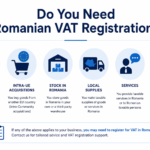
Ask this before issuing your first invoice, not after. Registration frequently becomes mandatory long before any turnover threshold is relevant — triggered by imports, intra-EU acquisitions, holding stock in Romania, local supplies or certain services.
→ Full detail: VAT Registration in Romania: A Practical Guide for Foreign Companies
Step 6 — Set Up Accounting and Payroll
Bookkeeping procedures, invoice workflows, VAT coding, document retention and payroll should exist before commercial operations begin, not after the first month’s transactions have accumulated.
Pre-Trading Checklist
- ✓ Legal structure selected and justified
- ✓ CAEN activities defined
- ✓ Company registered with ONRC
- ✓ Corporate bank account opened and online banking active
- ✓ VAT position assessed
- ✓ Accounting provider appointed
- ✓ Payroll planned, if hiring
- ✓ Digital reporting obligations reviewed (e-Factura, SAF-T)
- ✓ Internal financial procedures documented
Planning your Romanian entry?
A short structuring conversation before incorporation is considerably cheaper than restructuring afterwards. Request an initial consultation →
Corporate Taxation in Romania
The useful question is not “what is the corporate tax rate” but “how will this business actually be taxed”. The answer depends on structure, activities, financing, cross-border flows, regime eligibility and treaty access.
| Tax | Rate | Applies to |
|---|---|---|
| Corporate income tax | 16% | Taxable profit — accounting profit adjusted per tax legislation |
| Microenterprise tax | 1% of revenue | Qualifying small companies below the turnover threshold |
| Dividend tax | 16% | Distributions — reducible under treaties or the EU Parent-Subsidiary Directive |
| Withholding tax | Varies by income type | Interest, royalties, services paid to non-residents |
| Salary taxes and contributions | See payroll section | Employment income |
Corporate Income Tax: Accounting Profit Is Not Taxable Profit
Taxable profit starts from the accounting result and is then adjusted — non-deductible expenses, non-taxable income, depreciation differences, loss carry-forwards and fiscal incentives. Two companies with identical accounting profits can owe materially different tax.
Expenses incurred for business purposes are generally deductible where properly documented, but Romanian law contains detailed rules on partially deductible and non-deductible categories. Documentation quality directly determines the outcome of an inspection.
The Microenterprise Regime
Romania’s microenterprise regime taxes revenue rather than profit, which can be highly advantageous for smaller operations — but eligibility conditions and thresholds have tightened repeatedly, and the regime is not always the better outcome once profitability rises.
→ Full analysis: Microenterprise Tax in Romania: Key Changes, Pros and Cons
Dividends and Profit Repatriation
Distribution planning should account for domestic rules, applicable double tax treaties, EU Parent-Subsidiary relief and withholding mechanics. Planning distributions before year-end is consistently more efficient than addressing them afterwards.
Transfer Pricing
Intra-group transactions — management services, loans, royalties, software licences, shared service arrangements — must reflect arm’s-length conditions. Romanian documentation requirements are detailed and increasingly enforced. Establish a policy at the outset rather than assembling documentation during an inspection.
Permanent Establishment Risk
Foreign companies frequently assume Romanian activity can be conducted without creating a local tax presence. Depending on what actually happens on the ground — maintaining an office, employing staff, running construction projects, concluding contracts locally — a permanent establishment may arise, bringing Romanian tax obligations with it.
R&D Incentives
Romania offers incentives for qualifying research and development activity, including a credit mechanism introduced under OUG 8/2026 that can materially affect the effective tax position of companies with genuine R&D functions.
→ Full analysis: Romania R&D Tax Credit OUG 8/2026
VAT Registration and Compliance
For most foreign investors, VAT is the first tax issue with real operational consequences. Romania’s system is harmonised with the EU VAT Directive, but its practical application — particularly across borders — is where errors concentrate.
When Registration Becomes Mandatory
Turnover is the wrong test for most foreign companies. Registration should be assessed where a business imports goods, makes intra-EU acquisitions, stores inventory in Romania, supplies goods locally, provides services with a Romanian place of supply, or participates in chain or distance-selling transactions.
→ Full guide: VAT Registration in Romania
VAT Rates
Romania applies a standard rate of 21%, a reduced rate of 11% for qualifying supplies, and exemptions for specified activities. The applicable rate follows the nature of the transaction — never assume a product taxed at a reduced rate in one Member State receives the same treatment here.
Reverse Charge and Cross-Border Trade
Many international transactions do not carry Romanian VAT on the invoice; the reverse charge applies instead. Whether it does depends on where the customer is established, the place of supply, the customer’s VAT status and the nature of what is supplied. Misapplied reverse charge is among the most frequent findings in VAT inspections.
Businesses trading across borders will regularly encounter intra-EU acquisitions and supplies, exports, imports, and chain or triangular transactions — each with distinct VAT consequences. As volumes grow, procedural discipline matters more than technical knowledge.
Digital Reporting: e-Factura, SAF-T and e-Transport
Romania has one of the EU’s most developed digital tax administrations. This is an advantage once implemented and a significant obstacle if left until the deadline.
| System | What it does | Practical impact |
|---|---|---|
| RO e-Factura | Routes invoices through a state platform rather than directly to customers | Invoicing workflows and ERP output formats need adjusting before the first invoice |
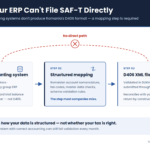
| SAF-T (D406) | Structured XML file of accounting and transactional data | Requires clean master data and precise account mapping; the hardest of the three to retrofit |
| RO e-Transport | Declares movements of goods on Romanian territory | Affects logistics and dispatch processes, not just finance |
What This Means for Your ERP
These systems consume structured accounting data rather than summary tax returns. That shifts the compliance burden upstream, into how transactions are recorded in the first place. Implementation typically requires accounting, tax, IT, logistics and procurement to coordinate — which is why it should influence your choice of accounting software, not follow it.
Before operations begin, review ERP capabilities, invoice workflows, customer and supplier master data, VAT coding, account mappings and document retention procedures.
Accounting and Financial Reporting
Every Romanian company must maintain statutory accounting records under Romanian accounting regulations, with IFRS applying to certain categories of entity. Accounting quality determines VAT reporting accuracy, corporate tax outcomes, payroll correctness and audit exposure — it is the foundation everything else sits on.
Many international businesses outsource bookkeeping, VAT compliance, payroll, financial statements and management reporting rather than building an internal finance function for a subsidiary. Annual statutory financial statements are generally required, with statutory audit applying above certain size criteria.
The practical advice is unglamorous but consistently correct: accurate monthly bookkeeping makes year-end straightforward, and nothing else does.
Employment and Payroll
Romania offers one of Central and Eastern Europe’s largest pools of skilled professionals, and many foreign companies establish subsidiaries specifically to recruit engineers, developers, finance specialists and multilingual support teams.
Employing staff creates obligations that sit across HR, accounting and tax simultaneously. Employers are responsible for calculating salary taxes and mandatory social contributions, preparing payroll reports, maintaining employment documentation, submitting statutory declarations, and paying both employees and payroll taxes on time.
Before recruiting, establish employment contract templates, payroll procedures, employee registration processes and the integration between payroll and accounting. Benefits such as meal vouchers, private medical insurance, bonuses and pension contributions each carry their own tax treatment and should be reviewed before being offered.
Banking and Cash Flow
Banks will request registration documents, shareholder and UBO information, director and signatory identification, intended activities, expected transaction volumes and source of funds. Multi-jurisdiction ownership structures attract additional verification, and onboarding timelines are routinely underestimated.
Beyond account opening, cash flow discipline matters more than most subsidiaries anticipate: customer collections, supplier payments, payroll, VAT liabilities, corporate tax payments and FX exposure all need monitoring. Profitable companies encounter difficulties when inflows and outflows are managed reactively. Monthly cash flow forecasting is standard practice for businesses of any size.
Your Annual Compliance Calendar
Doing business in Romania on an ongoing basis means a recurring compliance cycle that does not end at incorporation. Understanding it allows you to resource it properly rather than react to deadlines.
| Frequency | Obligations |
|---|---|
| Monthly | Record transactions; reconcile bank accounts; review supporting documentation; prepare and submit VAT returns where applicable; process payroll, calculate contributions and submit payroll declarations; SAF-T submission where applicable |
| Quarterly | Review tax position, financial performance, transfer pricing exposure, compliance procedures and internal controls |
| Annually | Prepare financial statements; corporate income tax reporting; inventory procedures; statutory audit where applicable; review accounting policies and tax risks |
Quarterly reviews exist to surface problems while they remain inexpensive to fix. Year-end handled as a single deadline is invariably more costly than year-end prepared continuously.
Seven Mistakes Foreign Investors Make
- Treating incorporation as the finish line. Registration is the start of the compliance obligation, not the completion of setup.
- Delaying VAT analysis. By the time the first invoice is issued, registration may already have been required — with retroactive consequences.
- Copying group structure from another jurisdiction. What works in Poland or Germany may be materially suboptimal in Romania.
- Underestimating documentation. Romanian compliance is evidence-driven. Incomplete records convert defensible positions into adjustments.
- Ignoring digital reporting until it is mandatory. e-Factura and SAF-T require clean, structured data. Retrofitting is far harder than designing for it.
- Treating accounting as an administrative cost. It is the primary source of management information about profitability, liquidity and performance.
- Seeking advice after the transaction. Advice taken before a decision expands your options; advice taken afterwards mostly documents them.
How TaxOlia Supports Foreign Investors
We advise foreign companies at every stage of doing business in Romania — across the full lifecycle of their local operations — from structuring and incorporation through to ongoing compliance — with particular depth in non-resident taxation and digital reporting.
- Company formation
- Accounting and bookkeeping
- VAT registration and compliance
- Corporate tax advisory and transfer pricing
- Payroll services
- SAF-T and e-Factura implementation
- Tax audit assistance
Ready to expand into Romania?
Whether you are evaluating the market or already operating locally, we can help you build a compliant, efficient structure — and keep it that way. Contact TaxOlia for an initial consultation →
Ready to expand into Romania?
Whether you are evaluating the market or already operating locally, we can help you build a compliant, efficient structure — and keep it that way. Contact TaxOlia for an initial consultation →
Frequently Asked Questions
How long does it take to set up a company in Romania?
Trade Register registration itself is relatively quick once documentation is complete. The realistic timeline is driven by document preparation — translations, notarisation and apostille for foreign shareholders — and by bank account opening, which involves AML and KYC verification.
Do I need a Romanian resident director?
A Romanian company can generally be directed by non-residents. However, practical considerations — bank onboarding, day-to-day representation and, importantly, permanent establishment analysis for the parent — mean management arrangements should be reviewed rather than assumed.
What is the minimum share capital for an SRL?
The minimum is nominal — effectively RON 1. In practice, capitalise the company adequately for its intended activity: banks, suppliers and counterparties draw conclusions from share capital, and thin capitalisation creates its own tax questions.
Is the microenterprise regime always better than corporate income tax?
No. Taxing revenue rather than profit favours businesses with strong margins and low costs, but penalises low-margin, high-turnover models. Eligibility conditions have also tightened repeatedly. The comparison should be run on your actual projected figures.
When does a foreign company create a permanent establishment in Romania?
It depends on the substance of local activity — an office, employees, construction projects or contract conclusion in Romania are common triggers — assessed under both Romanian law and the applicable double tax treaty. The analysis should precede operations.
Can a foreign company do business in Romania without incorporating?
Sometimes, through VAT registration alone, a branch, or direct cross-border supply. Whether that is workable depends on the activity and on permanent establishment exposure. It is a genuine option worth analysing rather than a default.
Do I need to register for VAT immediately after incorporation?
Not automatically — but the assessment should happen before the first taxable transaction. Many foreign companies must register well before reaching any turnover threshold, because of imports, intra-EU acquisitions or holding stock in Romania.
Is RO e-Factura mandatory for my company?
Applicability depends on transaction type and the parties involved. Any company operating in Romania should establish its e-Factura position before issuing invoices, since it changes invoicing workflow rather than merely adding a report.
Can I use my existing accounting software for Romanian compliance?
Often yes for bookkeeping, but foreign systems rarely produce Romanian-compliant SAF-T output natively. A structured mapping process between your existing export and the required XML format is usually more proportionate than reconfiguring a group ERP.
Can accounting and payroll be outsourced entirely?
Yes, and most foreign subsidiaries do. Outsourced scope typically covers bookkeeping, VAT compliance, payroll, financial statements, tax reporting and management reporting, allowing management to focus on commercial operations.
How are dividends taxed when repatriating profits?
Dividends are subject to withholding at the domestic rate, which may be reduced under an applicable double tax treaty or eliminated under the EU Parent-Subsidiary Directive where conditions are met. Structure and timing both affect the outcome.
What happens if my company is selected for a tax inspection?
Inspections focus heavily on documentation: supporting evidence for deductions, related-party transaction files, VAT treatment and reconciliation between declarations. Companies with organised records and consistent filings generally experience shorter, narrower inspections.
Great info. Thanks a lot. Everything in one place.