Reading time: 10 min
For most foreign companies entering the Romanian market, VAT registration in Romania is the first compliance decision with real financial consequences. The obligation often arises before the first invoice is issued — triggered by an import, an intra-EU purchase, or simply holding stock in a Romanian warehouse. Get the timing wrong and the cost is immediate: retroactive penalties, blocked refunds, or a filing history that invites inspection.
This guide covers who needs to register, what must be declared afterwards, how the process works for non-residents — and the technical obstacle most companies underestimate: producing compliant filings from an accounting system never designed to generate them.
Who Needs VAT Registration in Romania?
The most persistent misconception is that VAT registration in Romania depends on turnover. In practice, a Romanian VAT number often becomes mandatory long before any threshold is relevant — the trigger is the transaction type, not the amount.
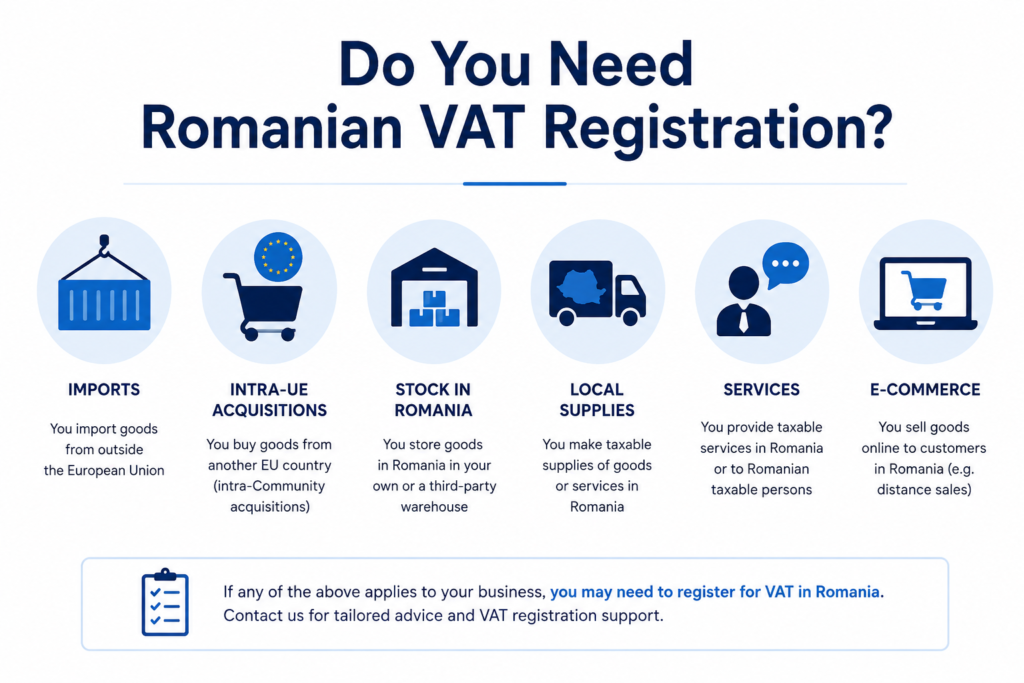
Registration typically needs to be assessed where a company:
- imports goods into Romania from outside the EU;
- makes intra-EU acquisitions of goods delivered to Romania;
- stores inventory in Romania, including through a fulfilment centre or 3PL provider;
- makes local supplies of goods to Romanian customers;
- supplies services where the place of supply is Romania and the reverse charge does not apply;
- carries out chain, triangular or distance-selling transactions involving Romania.
A common pattern: an e-commerce business moves stock into a Romanian warehouse ahead of a seasonal peak. No sales yet, no threshold crossed — but the movement of goods itself creates the obligation. By the time the first order ships, the company is already late.
TaxOlia Insight: We regularly advise companies that sit comfortably below Romania’s domestic registration threshold yet still require a Romanian VAT number because of a single cross-border flow. Turnover is the wrong question. The right one is: what moves, where does it move, and who is the customer?
How Non-Residents Register: Form 015 and Fiscal Representation
A foreign company without a fixed establishment in Romania registers for VAT through Form 015, submitted to ANAF’s dedicated administration for non-resident taxpayers. The documentation required depends primarily on where the company is established.
| Company established in | Typical requirement |
|---|---|
| An EU Member State | Direct registration possible; a fiscal agent may be appointed but is not generally mandatory |
| Outside the EU | Appointment of a fiscal representative established in Romania is normally required |
Supporting documents usually include incorporation and constitutional documents, a VAT status certificate from the home tax authority, evidence of the triggering activity (contracts, purchase orders, transport documents), and identification for the legal representative. Foreign documents generally need certified Romanian translation and, depending on origin, notarisation or apostille.
The most frequent cause of delay is not ANAF processing — it is incomplete paperwork returning for correction. Preparing translations and apostilles alongside the first commercial contract, rather than after it, is the most effective way to close the gap between the first taxable transaction and an active VAT number.We can assist you on the VAT registration in Romania. Contact us.
What You Must Declare Once Registered for VAT
Registration is the beginning of the obligation, not the end of it. Once a Romanian VAT number is active, the company enters a recurring reporting cycle:
| Filing | What it covers | Frequency |
|---|---|---|
| D300 — VAT return | Output and input VAT for the period | Monthly or quarterly |
| D390 — Recapitulative statement | Intra-EU supplies and acquisitions | Monthly, when applicable |
| D394 — Informative declaration | Domestic transactions with Romanian counterparties | Monthly or quarterly, where applicable |
| D406 — SAF-T | Structured accounting and transactional data | Monthly or quarterly |
On top of these sits RO e-Factura, Romania’s mandatory electronic invoicing system, which routes invoices through a state platform rather than directly to the customer.
The Technical Challenge: Filing Without a Romanian Accounting System
Here is where most foreign companies hit a wall that has nothing to do with tax law and everything to do with data structure.
A company running SAP, NetSuite, Xero, QuickBooks or any ERP configured for another jurisdiction does not produce output in the shape Romanian authorities expect. SAF-T follows a rigid XML schema with prescribed field mappings, code lists and validation rules unlike any standard trial balance or invoice register export.
So someone has to take raw transactional data — invoices, VAT codes, counterparty identifiers, tax rates — and reshape it into a compliant filing. Every month. Done manually, this is slow and fragile: as volumes grow, so does the chance that one miscoded line distorts an entire submission.
The usual alternatives are expensive. Reconfiguring a group ERP is a project measured in months and consultant fees. Parallel Romanian books duplicate work and create two versions of the truth. Neither is proportionate for a subsidiary processing a few hundred transactions a month.
How We Solve It: A Structured Template That Generates the Filings
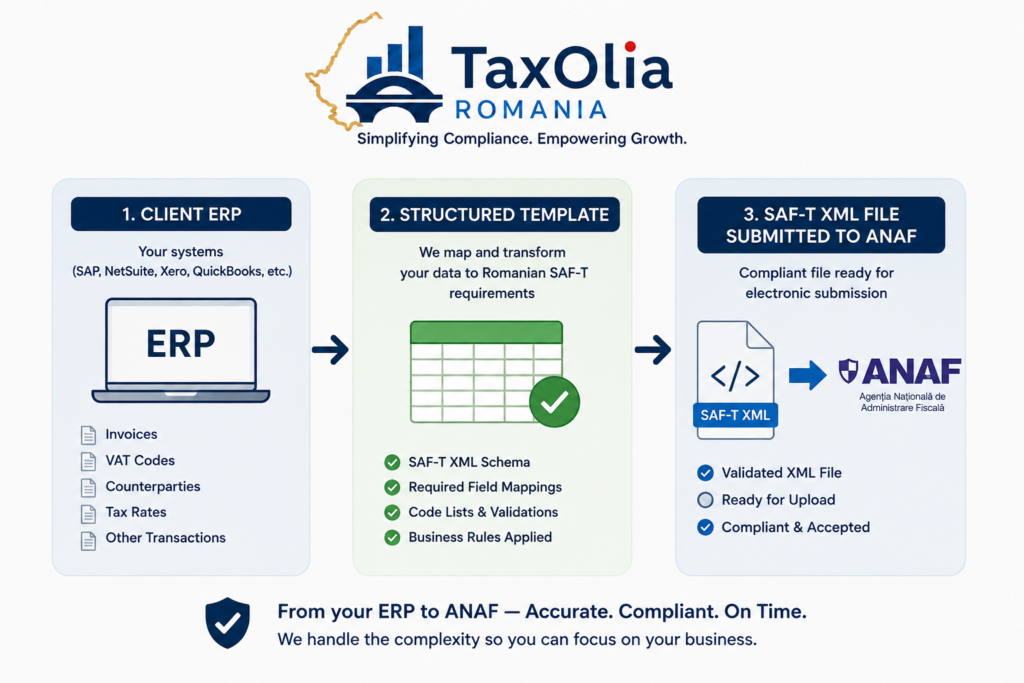
To remove this bottleneck, TaxOlia built a standardised Excel template that sits between the client’s existing accounting export and Romania’s filing requirements. No ERP reconfiguration, no parallel bookkeeping.
The process runs in three steps:
- Export — the client exports transactional data from the system they already use, in a familiar format;
- Map — the data is loaded into our structured template, which carries the Romanian VAT logic, code lists and built-in validation checks;
- Generate — the template produces the VAT return, the recapitulative statement and the SAF-T XML file, ready for submission.
Because the mapping logic lives in the template rather than in someone’s memory, the process is repeatable and auditable. The same rules apply in month twelve as in month one, validation catches coding errors before submission, and the monthly cycle becomes routine rather than a scramble.
TaxOlia Insight: The companies that find Romanian VAT compliance painless are rarely those with the most sophisticated ERP. They are the ones with a reliable, repeatable way of turning the data they already have into a compliant filing — month after month, without rebuilding the process each time.
Why This Matters Beyond Compliance
Treating VAT as purely administrative understates the exposure. Late registration can mean penalties calculated retroactively from the first taxable transaction. Inconsistent filings delay refunds, tying up working capital for months. And an inspection triggered by reconciliation mismatches consumes management time far out of proportion to the underlying error.
A defined process — assessed registration timing, a reliable monthly routine, and a repeatable method for producing SAF-T — converts VAT from a standing risk into a predictable cost.
Getting Started with the VAT registration in Romania
Whether you are assessing if your business needs a Romanian VAT number, or already hold one and struggle to produce compliant SAF-T filings, TaxOlia can help — from registration analysis through to a repeatable monthly filing process.
Request a VAT Registration Assessment →
Frequently Asked Questions
Does VAT registration in Romania depend only on turnover?
No. Many foreign companies must do a VAT registration in Romania well before reaching any domestic threshold, because of imports, intra-EU acquisitions, holding stock in Romania, or making local supplies, according to the Fiscal Code. The transaction type matters more than the amount.
Do I need a fiscal representative to register for Romanian VAT?
Companies established outside the EU generally must appoint a fiscal representative established in Romania. EU-established companies can usually register directly, though a fiscal agent may still be appointed for practical reasons.
How long does VAT registration take in Romania?
Timing depends heavily on documentation quality. The most common cause of delay is incomplete paperwork — missing translations, apostilles or evidence of the taxable activity — rather than the authority’s processing itself. Preparing documents in advance materially shortens the timeline.
Can I produce SAF-T (D406) reports without a Romanian accounting system?
Yes. A structured mapping process can convert data from most standard ERP or accounting exports into a compliant SAF-T file, without changing your accounting software or maintaining parallel Romanian books. We have a simple solution.
What happens if I register for VAT late in Romania?
Obligations are generally assessed from the moment the registration requirement arose, not from the date the number was issued. This can mean retroactive VAT liabilities plus penalties and interest, which is why the assessment should happen before the first taxable transaction.
Do I need to file SAF-T if I have no Romanian transactions in a given period?
Reporting obligations generally continue for as long as the VAT registration is active, even in periods with limited or no activity. The specific treatment of nil periods should be confirmed for your registration type.
Can a foreign company deregister from Romanian VAT?
Yes, where the activity that triggered registration has genuinely ceased. Deregistration requires a formal application and normally settlement of outstanding filings and liabilities. Companies that expect to resume Romanian activity should weigh deregistration against the cost of re-registering later.
Is RO e-Factura mandatory for non-resident companies registered for VAT?
Applicability depends on the transaction type and the parties involved. Any company registered for Romanian VAT should assess its e-Factura position alongside registration, as invoicing workflows usually need adjusting before the first invoice is issued. But normally these companies have to produce E-Factura and send it to ANAF for reporting purposes in parallel to their standard invoicing flow.
Want to register for VAT in Romania?
We can assist yo with this. Everything online. Contact us →