
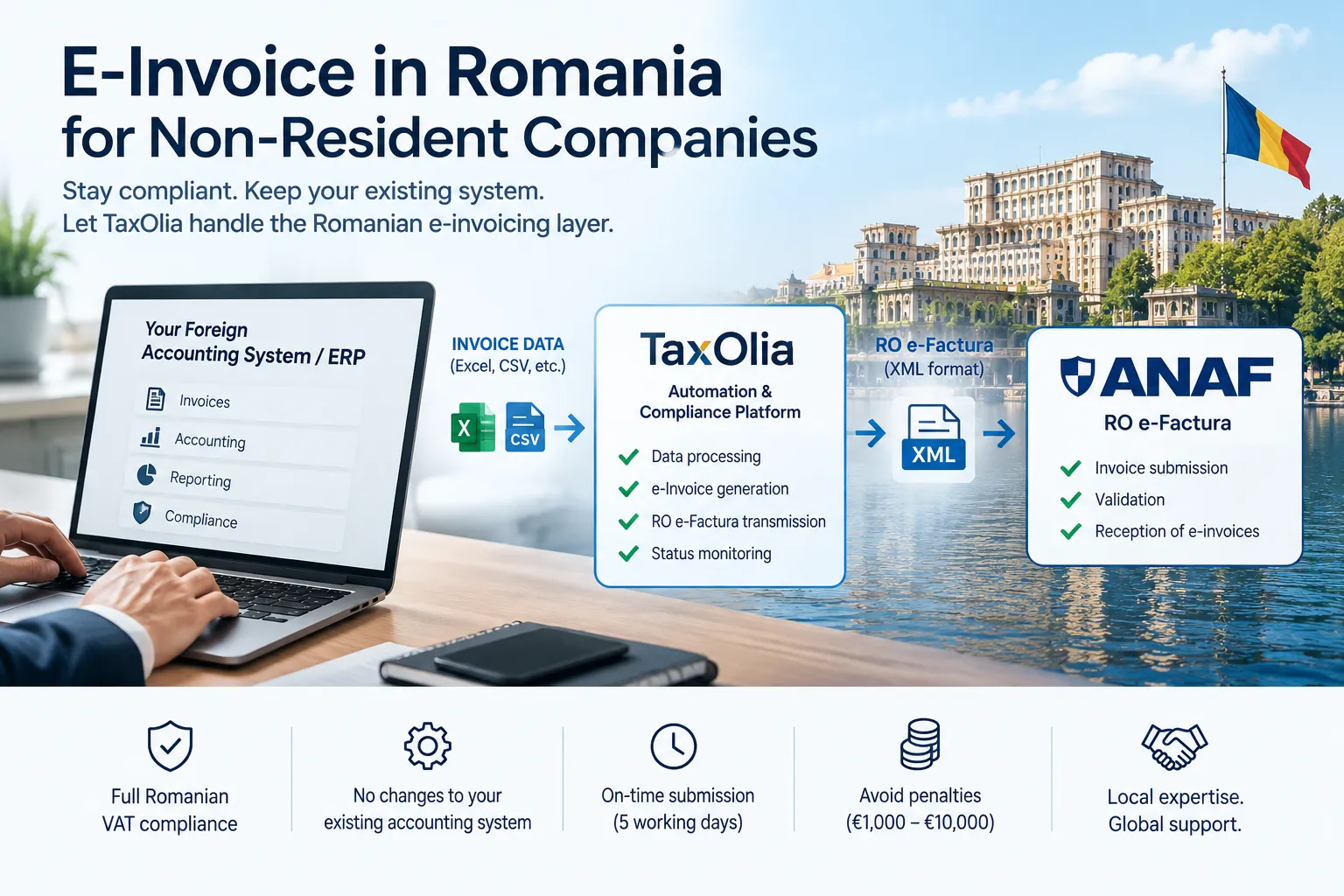
 Non-resident companies registered for VAT in Romania face specific RO e-Factura requirements that can be difficult to manage through a foreign accounting or ERP system. Romanian e-invoicing rules require certain invoices issued by non-resident VAT-registered companies to be transmitted through the Romanian national RO e-Factura system, in addition to the company’s normal invoicing process.
RO e-Factura Requirements for Non-Resident Companies
Under Romanian tax legislation, a company that is not established in Romania but is registered for Romanian VAT can be required to transmit invoices through RO e-Factura when it makes B2B supplies of goods or services whose place of supply is in Romania.
The rules were introduced specifically for non-resident taxable persons by the Romanian tax legislation applicable from 1 January 2024 and have subsequently been amended. The current framework continues to make RO e-Factura highly relevant for non-resident companies with a Romanian VAT registration.
This means that a foreign company may have to operate with two connected invoicing processes: its normal commercial invoice generated through its international accounting or ERP system, and the Romanian electronic invoice transmitted through the RO e-Factura system.
What Does This Mean in Practice?
A non-resident company may continue to issue its standard invoice to its customer using its existing foreign accounting system. However, the relevant invoice data must also be converted into the Romanian electronic invoice format and transmitted through the Romanian tax administration’s RO e-Factura platform.
RO e-Factura is based on a structured electronic invoice rather than simply uploading a PDF. This means that invoice data must comply with the technical requirements of the Romanian system, including the applicable electronic invoice structure and coding requirements.
Receiving E-Invoices from Romanian Suppliers
RO e-Factura is also becoming increasingly important for receiving invoices. From 2026, Romanian-established suppliers are required, subject to the applicable exceptions, to transmit invoices through RO e-Factura for Romanian-place-of-supply transactions made to non-resident companies that are registered for VAT in Romania.
For foreign companies, this creates another challenge: invoices received through the Romanian tax administration system may need to be downloaded, reviewed and transferred into an accounting or ERP system that is located outside Romania.
Why Is RO e-Factura Difficult for Foreign Companies?
Most international accounting systems are not designed specifically for the Romanian RO e-Factura system. A non-resident company may therefore need a separate Romanian compliance process for generating XML invoices, transmitting them to ANAF, checking their status and retrieving received e-invoices.
Access to Romanian tax administration systems can also create practical difficulties. Companies may need appropriate ANAF/SPV access, authentication credentials, electronic signatures or authorised representatives. For a foreign finance team with no Romanian infrastructure, managing these requirements internally can be unnecessarily complex. We aim to take this additional burden from you and created a process in which we will issue the e-invoice on behalf based on the information we receive in Excel/CSV as downloaded from your accounting system. We would be happy to discuss.
RO e-Factura Deadlines and Penalties
Where transmission through RO e-Factura is required, the current deadline is generally 5 working days from the invoice date, subject to the statutory maximum deadline linked to the legal invoice issuance date.
Failure to transmit invoices within the applicable deadline can result in penalties. Current legislation provides fines ranging from RON 1,000 to RON 10,000, depending on the taxpayer’s classification. This makes reliable and timely e-invoice processing an important part of Romanian VAT compliance.
TaxOlia E-Invoice Automation for Non-Resident Companies
TaxOlia helps non-resident companies manage Romanian e-invoicing without replacing their existing international accounting or ERP system.
Our proprietary automation tools are designed specifically to bridge the gap between a foreign accounting system and the Romanian RO e-Factura requirements. Companies can provide invoice information to TaxOlia in practical formats such as Excel, CSV or other structured data formats.
TaxOlia can then transform the relevant information into the Romanian electronic invoice format and manage the Romanian e-invoicing process, including transmission through the appropriate ANAF/RO e-Factura channel.
This allows a foreign company to keep its existing accounting system while outsourcing the Romanian-specific e-invoicing and compliance layer to a local specialist.
A Simple Romanian E-Invoice Solution for Foreign Businesses
For a non-resident company with a Romanian VAT number, implementing a completely new Romanian accounting system is often unnecessary. A dedicated Romanian e-invoicing solution can connect the company’s existing financial processes with the local compliance requirements.
TaxOlia combines Romanian VAT expertise, tax compliance support and proprietary automation technology to help foreign businesses manage RO e-Factura efficiently and reduce the administrative burden associated with Romanian VAT compliance.
If your company is registered for VAT in Romania and needs help with Romanian tax compliance and VAT services, TaxOlia can provide a practical solution for your Romanian e-invoicing requirements.
Need help with RO e-Factura?
Let TaxOlia handle your Romanian e-invoicing and VAT compliance, while you keep your existing accounting system.
Contact Us